V-Beam Laser Treatment in Gangnam, Seoul
Cheongdam JCELL Dermatology Clinic
Explore V-Beam laser care at Cheongdam JCELL Dermatology Clinic in Gangnam, Seoul, with targeted treatment designed to address visible redness, vascular concerns, and uneven skin tone.
V-Beam laser treatment is a vascular laser procedure used to address visible redness and blood vessels in the skin. It may be considered for facial redness, rosacea, visible capillaries, broken blood vessels, and certain red marks.
At Cheongdam JCELL Dermatology Clinic, patients receive personalized dermatology care in Cheongdam, Gangnam, Seoul. Treatment is planned according to each patient's skin condition, vascular concerns, sensitivity, and desired results.
For international patients living in Korea or visiting Seoul, professional consultation can help determine whether V-Beam treatment is appropriate and which treatment approach may be most suitable.
What Is V-Beam Laser Treatment?
V-Beam is a pulsed dye laser designed to target blood vessels beneath the skin. The laser energy is absorbed by hemoglobin within targeted vessels, allowing treatment to focus on vascular structures.
V-Beam may be considered for:
- Facial redness
- Visible capillaries
- Broken blood vessels
- Rosacea-related redness
- Facial flushing
- Red acne marks
- Selected vascular lesions
- Localized vascular discoloration
Unlike lasers primarily designed for pigmentation or skin resurfacing, V-Beam focuses on vascular concerns.
The treatment is most appropriate when blood vessels are an important contributor to the patient's skin concern.
How Does V-Beam Work?
V-Beam delivers controlled pulses of laser energy to selected areas of the skin. Hemoglobin in the targeted blood vessels absorbs the laser energy.
The treated vascular structures are then gradually processed by the body.
Treatment involves:
- Identifying the vascular concern
- Selecting the appropriate treatment area
- Adjusting laser parameters
- Delivering controlled laser pulses
- Protecting surrounding skin
- Allowing the skin to recover
Treatment settings can vary depending on the patient's skin tone, vascular characteristics, treatment area, and individual response.
A stronger setting is not necessarily better.
The goal is to use an appropriate treatment intensity for the patient's specific skin condition.
What Skin Concerns Can V-Beam Treat?
V-Beam is primarily used for skin concerns associated with visible redness or superficial blood vessels.
It may be considered for:
- Persistent facial redness
- Facial flushing
- Visible capillaries
- Broken blood vessels
- Rosacea
- Red acne marks
- Post-inflammatory redness
- Selected vascular lesions
Some patients have several factors contributing to facial redness.
For example, rosacea may involve both vascular changes and inflammation. Sensitive skin may also make redness more noticeable.
A dermatologist can assess the skin to determine whether vascular treatment is appropriate.
V-Beam for Facial Redness
Persistent facial redness is one of the most common reasons patients consider vascular laser treatment.
Redness may appear on areas such as:
- Cheeks
- Nose
- Chin
- Forehead
- Around the mouth
- Other localized areas
Some patients have a generally flushed complexion, while others have clearly visible vessels.
V-Beam may be considered when superficial vascular changes are contributing to the appearance of redness.
However, facial redness does not always have a vascular cause.
Other possible causes include:
- Sensitive skin
- Dermatitis
- Acne inflammation
- Sun exposure
- Skin irritation
- Pigmentation
- Environmental factors
Identifying the cause of redness is an important first step before selecting a laser treatment.
V-Beam for Rosacea
Rosacea is a common reason patients seek vascular laser treatment.
It can involve:
- Persistent facial redness
- Recurrent flushing
- Visible blood vessels
- Burning
- Stinging
- Skin sensitivity
- Inflammatory bumps
V-Beam may help address the vascular component of rosacea.
However, rosacea can involve more than visible blood vessels. Some patients may also need medical treatment, trigger management, and appropriate skincare.
A comprehensive treatment plan may include:
- Dermatologic evaluation
- Medical management
- Vascular laser treatment
- Gentle skincare
- Skin-barrier support
- Sun protection
- Trigger avoidance
V-Beam can be one part of a broader rosacea management strategy.
V-Beam for Visible Capillaries
Small visible capillaries around the nose and cheeks can become a noticeable cosmetic concern.
They may appear as:
- Fine red lines
- Small branching vessels
- Redness around the nostrils
- Cheek capillaries
- Localized red vessels
V-Beam can be considered when these vessels are superficial and suitable for vascular laser treatment.
The dermatologist may assess the size, number, location, and appearance of the vessels before treatment.
Patients with a few localized vessels may have different treatment needs from those with widespread facial redness.
V-Beam for Broken Blood Vessels
Broken or enlarged superficial blood vessels can develop on visible areas of the face.
They may become more noticeable because of:
- Sun exposure
- Aging
- Repeated flushing
- Skin sensitivity
- Environmental factors
- Underlying vascular conditions
Common areas include:
- Around the nose
- Cheeks
- Chin
- Other facial areas
V-Beam may be considered for selected visible vessels.
The appropriate treatment depends on the characteristics of each vessel and the surrounding skin.
V-Beam for Red Acne Marks
Acne can leave behind red or pink marks after active breakouts have improved.
These marks can look similar to pigmentation, but they are not necessarily the same type of skin concern.
A dermatologist may determine whether the remaining mark is:
- Post-inflammatory redness
- Pigmentation
- Active inflammation
- A vascular change
- Acne scarring
When vascular redness is a significant component, V-Beam may be considered.
Treatment should not be selected based only on color.
Red marks, brown pigmentation, and acne scars can require different treatment approaches.
V-Beam Treatment at Cheongdam JCELL Dermatology Clinic
At Cheongdam JCELL Dermatology Clinic, V-Beam treatment is planned according to the patient's individual skin and vascular concerns.
The dermatologist may consider:
- Location of redness
- Severity of redness
- Visible blood vessels
- Skin tone
- Skin sensitivity
- Pigmentation tendency
- Rosacea symptoms
- Previous laser treatments
- Previous treatment response
- Desired results
Facial V-Beam Treatment
V-Beam may be used on selected areas of the face when vascular redness is the main concern.
Treatment areas can include:
- Cheeks
- Nose
- Chin
- Forehead
- Around the mouth
- Other localized areas
The entire face does not always need to be treated.
Treatment areas can be selected according to the patient's individual concerns.
Localized Vascular Treatment
Some patients are primarily concerned about a small number of visible blood vessels.
Treatment may therefore focus on specific areas.
Examples include:
- Small vessels around the nose
- Individual cheek capillaries
- Localized red marks
- Small vascular lesions
The treatment approach depends on the characteristics of each area.
V-Beam and Different Skin Types
Skin tone and pigmentation tendency are important considerations when planning laser treatment.
Before treatment, the dermatologist may evaluate:
- Natural skin tone
- Skin sensitivity
- Pigmentation tendency
- Skin-barrier condition
- Previous laser reactions
- Recent sun exposure
- Previous dermatologic procedures
Patients with a tendency toward pigmentation may require careful treatment planning.
Those with irritated or compromised skin may also need to improve their skin condition before undergoing certain procedures.
Personalized treatment helps balance vascular improvement with overall skin safety.
V-Beam for Sensitive Skin
Patients with sensitive skin may worry that laser treatment could increase irritation or redness.
Sensitive skin can involve:
- Burning
- Stinging
- Dryness
- Tightness
- Flushing
- Redness after skincare
- Reactions to environmental changes
The dermatologist can assess the current condition of the skin before deciding whether treatment is appropriate.
Patients should mention:
- Recent exfoliation
- Retinoid use
- Active skincare ingredients
- Previous laser treatments
- Previous reactions
- Current irritation
If the skin is highly irritated, treatment timing or settings may need to be adjusted.
V-Beam Treatment Process
The exact treatment process may vary according to the patient's condition.
A typical appointment may include:
1. Skin Assessment
The dermatologist examines facial redness, visible vessels, skin sensitivity, and the overall condition of the treatment area.
2. Treatment Planning
The treatment area and laser parameters are selected according to the vascular concern.
3. V-Beam Treatment
Controlled laser pulses are delivered to the selected areas.
4. Cooling and Skin Care
Cooling or soothing measures may be used according to the treatment method and skin response.
5. Aftercare Guidance
Patients receive instructions regarding skincare, sun protection, heat exposure, and recovery.
Does V-Beam Laser Hurt?
Patients may feel warmth, tingling, or brief snapping sensations during treatment.
The level of discomfort can vary depending on:
- Treatment area
- Laser settings
- Number of pulses
- Individual sensitivity
- Type of vascular concern
Cooling technology may be used during treatment to improve comfort and protect the skin.
Patients with sensitive skin should inform the dermatologist about their sensitivity before treatment.
Recovery After V-Beam Treatment
Recovery varies according to the treatment settings and individual skin response.
Temporary effects may include:
- Redness
- Warmth
- Mild swelling
- Sensitivity
- Temporary darkening of vessels
- Small red or purple spots
- Bruising
Some patients experience minimal downtime.
Others may have more noticeable temporary changes after stronger vascular treatment.
After treatment, patients may be advised to:
- Use gentle skincare
- Keep the skin moisturized
- Protect the skin from sunlight
- Avoid excessive heat
- Avoid unnecessary friction
- Avoid harsh exfoliation
- Follow the clinic's aftercare instructions
Recovery should be considered when scheduling treatment around work, travel, or important events.
Sun Protection After V-Beam
Sun protection is an important part of post-treatment care.
Recently treated skin can be more sensitive to sunlight and irritation.
Patients may be advised to:
- Minimize direct sun exposure
- Use appropriate sunscreen
- Wear physical sun protection
- Avoid prolonged outdoor activities
- Follow recommended skincare instructions
This can be particularly important for international visitors spending time outdoors in Seoul.
If you are planning sightseeing or outdoor activities after treatment, discuss the expected recovery period during consultation.
How Many V-Beam Treatments Are Needed?
The number of treatments varies between patients.
Factors that may influence treatment frequency include:
- Severity of redness
- Number of visible vessels
- Vessel size
- Vessel depth
- Type of vascular concern
- Skin sensitivity
- Treatment settings
- Individual response
Some patients may notice improvement after an initial treatment.
Others may require several sessions for more persistent redness or visible vessels.
There is no universal number of treatments that applies to everyone.
The treatment schedule should be adjusted according to the patient's response and skin condition.
V-Beam Treatment for International Patients in Seoul
International patients may seek V-Beam treatment while visiting Seoul or living in Korea.
At Cheongdam JCELL Dermatology Clinic, international patients can discuss:
- Facial redness
- Rosacea
- Visible capillaries
- Broken blood vessels
- Red acne marks
- Facial flushing
- Sensitive skin
- Previous laser treatments
- Expected downtime
- Aftercare
- Follow-up recommendations
The clinic provides international patient-friendly dermatology care in Cheongdam.
This can make it convenient for visitors who want professional evaluation of vascular skin concerns during their stay in Seoul.
Travelers should consider their itinerary when scheduling treatment.
If extensive outdoor activities or important events are planned, treatment timing should take potential redness, swelling, or bruising into account.
V-Beam Compared With Other Laser Treatments
Different laser technologies are designed to address different types of skin concerns.
V-Beam is primarily associated with vascular treatment.
Other procedures may focus on pigmentation, resurfacing, or broader skin rejuvenation.
Depending on the patient's condition, treatment categories may include:
- V-Beam: Vascular redness and visible blood vessels
- Pigment lasers: Selected pigmentation concerns
- IPL: Certain combinations of redness and pigmentation
- CO2 laser: Resurfacing and selected skin lesions
- Other vascular lasers: Specific blood-vessel concerns
A patient with both redness and pigmentation may need a different approach from someone whose main concern is visible capillaries.
The appropriate procedure should be selected according to the actual cause of the skin concern.
When Should You Consider V-Beam Treatment?
A dermatology consultation may be appropriate if you have:
- Persistent facial redness
- Frequent facial flushing
- Visible capillaries
- Broken blood vessels
- Rosacea-related redness
- Red acne marks
- Localized vascular redness
- Redness that does not improve with skincare
- Repeated irritation associated with redness
Professional evaluation is particularly useful when the cause of redness is unclear.
Not every red area requires vascular laser treatment.
A dermatologist can first determine whether blood vessels are actually contributing to the appearance.
Why Choose Cheongdam for V-Beam Treatment in Seoul?
Cheongdam is located in Gangnam, Seoul, and is well known for its concentration of dermatology and aesthetic medical services.
The area is convenient for both local residents and international visitors seeking professional skin care.
Cheongdam is also accessible for patients staying around:
- Gangnam
- Apgujeong
- Sinsa
- COEX
- Samseong
- Seongsu
- Jamsil
- Itaewon
- Central Seoul
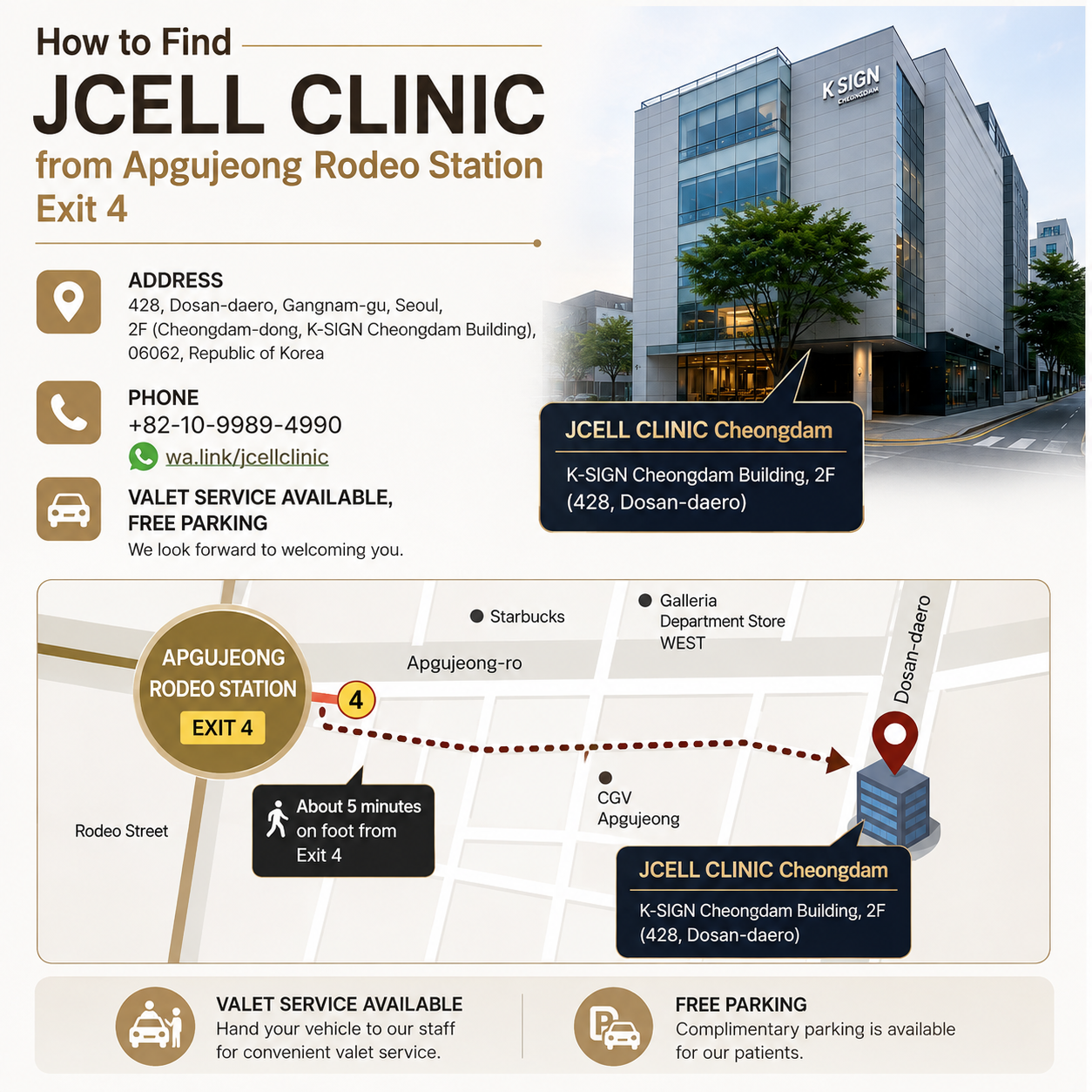
Cheongdam JCELL Dermatology Clinic is located at 428 Dosan-daero in Gangnam, near Apgujeong Rodeo Station Exit 4.
This location provides convenient access for patients traveling within Seoul.
Who May Consider V-Beam Treatment in Seoul?
V-Beam consultation may be suitable for patients who:
- Have persistent facial redness
- Experience frequent flushing
- Have visible facial capillaries
- Are concerned about broken blood vessels
- Have rosacea-related redness
- Have persistent red acne marks
- Want to improve an uneven-looking complexion
- Have sensitive or reactive skin
- Have tried skincare without sufficient improvement
- Are considering vascular laser treatment
- Want professional assessment before choosing a laser
- Are visiting Seoul for dermatology treatment
Patients with sudden, severe, or unusual skin changes should seek appropriate medical evaluation rather than assuming the concern is purely cosmetic.
Frequently Asked Questions
What is V-Beam laser used for?
V-Beam is a pulsed dye laser commonly used for vascular concerns such as facial redness, visible capillaries, rosacea-related redness, flushing, and selected red marks.
Can V-Beam reduce facial redness?
V-Beam may help reduce redness when superficial blood vessels are an important contributor. Results depend on the underlying cause, severity, treatment settings, and individual response.
Is V-Beam suitable for rosacea?
V-Beam may be considered for rosacea, particularly when persistent redness or visible blood vessels are prominent. Other rosacea symptoms may require additional dermatologic management.
Can V-Beam treat broken capillaries?
Yes. V-Beam may be considered for selected superficial broken capillaries. Treatment suitability depends on the size, location, depth, and characteristics of the vessels.
Can V-Beam treat red acne marks?
V-Beam may be considered when red acne marks are primarily related to post-inflammatory vascular changes. A dermatologist should distinguish redness from pigmentation and acne scarring before treatment.
Is V-Beam painful?
Patients may experience warmth, tingling, or brief snapping sensations during treatment. The level of discomfort varies according to the treatment area, settings, and individual sensitivity.
Does V-Beam have downtime?
Downtime varies. Temporary redness, swelling, sensitivity, or bruising can occur depending on the treatment settings and individual response.
How many V-Beam sessions will I need?
The number of sessions depends on the vascular concern, severity, treatment settings, and individual response. Some patients may require multiple sessions.
Can sensitive skin receive V-Beam treatment?
Potentially. Sensitive skin should be assessed before treatment, and laser parameters may need to be adjusted according to the current skin condition.
Can V-Beam permanently remove facial redness?
V-Beam can reduce selected vascular redness and visible vessels, but results vary. Conditions such as rosacea may recur and can require ongoing management.
Can foreigners get V-Beam treatment in Seoul?
Yes. International visitors and foreign residents can seek professional V-Beam consultation and treatment in Seoul. Cheongdam JCELL Dermatology Clinic provides international patient-friendly dermatology care.
Can I get V-Beam while traveling in Seoul?
Many visitors schedule dermatology treatments during their stay. Treatment timing should take possible redness, swelling, bruising, sun exposure, and follow-up requirements into consideration.
V-Beam Laser Treatment in Cheongdam, Gangnam
Cheongdam JCELL Dermatology Clinic provides personalized dermatology care for patients seeking V-Beam laser treatment in Seoul. Through professional skin and vascular assessment, patients can address concerns including facial redness, rosacea-related redness, visible capillaries, broken blood vessels, flushing, and selected red acne marks.
Treatment is planned according to the patient's vascular characteristics, skin tone, sensitivity, and individual goals. For international patients living in Korea or visiting Seoul,
Cheongdam JCELL Dermatology Clinic offers a convenient setting for professional V-Beam evaluation and treatment in
Cheongdam, Gangnam.